The Mission
Transforming how researchers explore academic literature through conceptual depth.

InsightScholar leverages hybrid transformer-based models trained on massive academic corpora like ArXiv and OpenAlex. The system resolves information overload by converting textual abstracts into high-dimensional semantic embeddings.
Combined with a rigorous Tag-Filtering mechanism, these embeddings enable researchers to discover orthogonal topics mathematically. To build academic trust, everything is backed by Explainable AI strategies (like SHAP and Anchors) to ensure the logic remains completely transparent.
The Engine


 K-Means Clustering Analysis


 PostgreSQL Database
System Architecture
How InsightScholar Works
A transparent, end-to-end framework turning massive open-access datasets into explainable, highly-relevant research recommendations.
01Data Collection & Corpus
InsightScholar connects to massive open-access repositories, including ArXiv, OpenAlex, S2ORC, and CORD 19. Hundreds of thousands of documents are indexed, pulling abstracts, titles, full texts, and comprehensive metadata into our secure database.


02Transformer Vectorization
Textual data (titles, abstracts) is processed through specialized language models like SciBERT and SPECTER. The models generate 768-dimensional mathematical embeddings capturing the deep semantic meaning and context of the research.
03Hybrid FAISS Retrieval
A user query is vectorized and compared against the corpus using Facebook AI Similarity Search (FAISS) for millisecond retrieval. Crucially, this vector search is combined with a Tag and Metadata filtering module—blending semantic discovery with precise author, venue, and citation structural data.


04Explainable AI Layer (XAI)
Before results are displayed, the black box is opened. Methods like SHAP (Shapley Additive Explanations) and Anchor-based local rule framing evaluate the model's decision, generating verifiable reasoning for why the paper fits the user's criteria.
05Metric Evaluation & UI
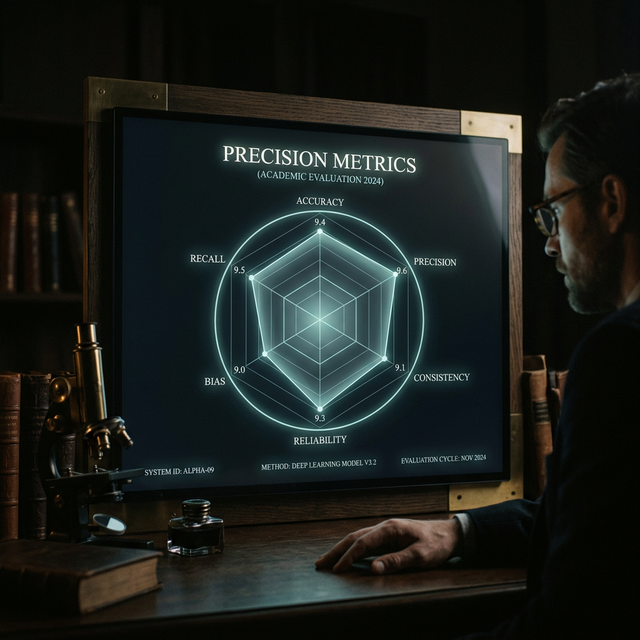
The final sorted recommendations are presented to the user alongside visual XAI charts. Behind the scenes, the model is continuously benchmarked using strict quantitative metrics like Precision@K, Recall@K, and NDCG to ensure maximum accuracy.
Looking Forward
We are continually expanding the horizon. Future iterations of InsightScholar will introduce:
- — Massive scale academic datasets
- — Hyper-personalized research workflows
- — Deep citation graph analysis
- — External academic database integration